Few fashion houses have disrupted, questioned, and redefined the industry as radically as Comme des Garçons. Founded in 1969 by Rei Kawakubo, the Tokyo-based label has spent decades dismantling traditional notions of beauty, luxury, and even wearability. Rather than following trends, Comme des Garçons (often abbreviated as CDG) has built its identity on intellectual rebellion. Through asymmetry, deconstruction, unconventional silhouettes, and an anti-fashion philosophy, the brand consistently challenges what clothing is supposed to be.
Rejecting Traditional Beauty Standards
When comme des garcons debuted in Paris in 1981, critics were stunned. The collection featured torn fabrics, oversized shapes, monochromatic black palettes, and garments that appeared unfinished. Some journalists referred to it as “Hiroshima chic,” shocked by its stark minimalism and distressed aesthetic.
At the time, European fashion was dominated by body-conscious glamour and structured elegance. Designers like Yves Saint Laurent and Gianni Versace celebrated sensuality and polish. Kawakubo, by contrast, presented clothes that obscured the body rather than accentuated it.
Her designs challenged the assumption that fashion must flatter. Instead of emphasizing curves, she often erased them. Instead of smooth perfection, she embraced holes, frays, and raw edges. In doing so, she rejected Western beauty ideals and proposed a radically different aesthetic language—one rooted in imperfection, ambiguity, and abstraction.
Deconstruction as Philosophy
Comme des Garçons became synonymous with deconstruction long before the term became mainstream in fashion. Garments appeared inside out. Seams were exposed. Jackets were reassembled with displaced panels and asymmetric cuts.
This approach was not accidental chaos. Kawakubo dissected conventional tailoring to reveal how garments are constructed. By exposing structure, she made the hidden visible. The result felt intellectual, almost architectural.
While other designers eventually adopted deconstruction, including Martin Margiela, Comme des Garçons treated it not as a trend but as a philosophy. Clothing became a site of inquiry: What happens when we distort proportion? What if a sleeve is too long? What if a dress grows outward instead of downward?
By dismantling traditional tailoring, the brand forced audiences to reconsider the very framework of garment design.
Redefining Silhouette and Form
One of Kawakubo’s most radical contributions lies in her reimagining of silhouette. Rather than following the natural lines of the human body, many Comme des Garçons collections introduce bulbous protrusions, padded distortions, or sculptural exaggerations.
The Spring/Summer 1997 collection, often called “Body Meets Dress, Dress Meets Body,” featured lumps sewn into garments that created unexpected shapes around hips, backs, and shoulders. These padded distortions challenged the notion that clothing should idealize or correct the body.
Instead of smoothing perceived “imperfections,” Kawakubo highlighted irregularity. The garments were provocative because they refused to conform to beauty norms. They asked whether fashion must always strive for harmony—or whether tension and discomfort could also be meaningful.
This radical approach continues to influence contemporary designers who explore fluidity, non-binary silhouettes, and post-human forms.
Anti-Fashion as Identity
Comme des Garçons operates within fashion while simultaneously resisting it. Kawakubo has often expressed skepticism toward trends and seasonal consumerism. Unlike brands that rely on predictable cycles of must-have items, CDG collections frequently resist easy commercial appeal.
This anti-fashion stance became especially evident in the brand’s conceptual runway presentations. Models sometimes walk in dim lighting. Soundtracks are haunting or minimal. Garments can be so sculptural they appear closer to art installations than ready-to-wear clothing.
In 2017, the Metropolitan Museum of Art honored Kawakubo with the exhibition “Rei Kawakubo/Comme des Garçons: Art of the In-Between.” The show explored themes of absence and presence, design and non-design, fashion and anti-fashion. Kawakubo became only the second living designer to receive such recognition, after Yves Saint Laurent.
The exhibition confirmed what many had long believed: Comme des Garçons transcends clothing. It occupies the space between art and fashion, challenging the boundaries that separate the two.
Commercial Subversion: The Play Line
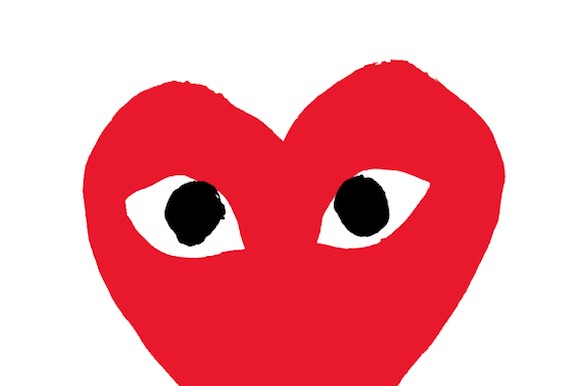

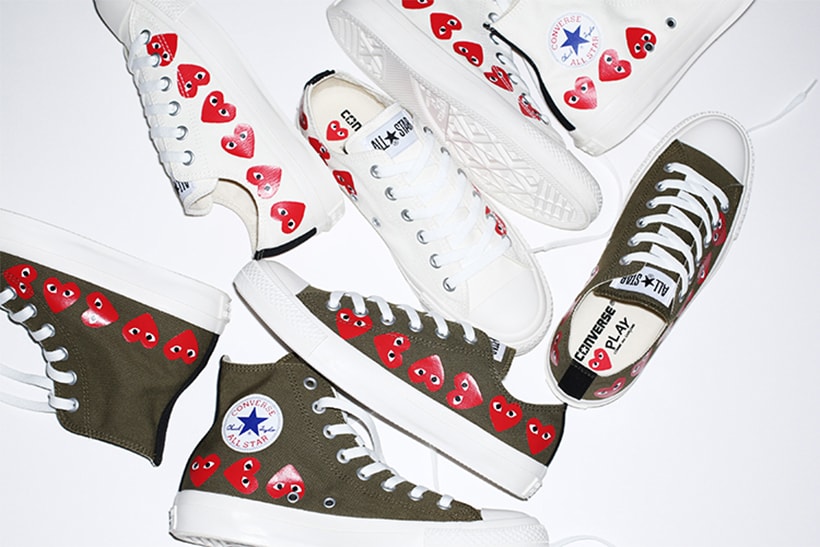
Despite its avant-garde reputation, Comme des Garçons has also mastered commercial strategy—without compromising its identity. The diffusion line Comme des Garçons Play, recognizable by its heart-with-eyes logo designed by Filip Pagowski, offers more accessible basics like striped shirts and cardigans.
Collaborations with Converse brought the brand to a global streetwear audience. Yet even these mass-appeal pieces maintain an element of subtle rebellion. The playful heart logo sits ironically on minimalist staples, blending subculture credibility with mainstream wearability.
Rather than diluting the brand, Play extends its reach while the mainline collections remain deeply experimental. This dual strategy allows Comme des Garçons to challenge fashion from within the system it critiques.
Gender Fluidity and Identity
Long before gender-neutral fashion became widely discussed, Comme des Garçons blurred the lines between menswear and womenswear. Oversized tailoring, androgynous silhouettes, and monochrome palettes destabilized traditional gender codes.
Kawakubo rarely defines her collections strictly by male or female archetypes. Instead, she designs around concepts. This conceptual approach opens space for interpretation and self-expression.
In contrast to brands that rely on hyper-masculine or hyper-feminine marketing, CDG questions whether such binaries are necessary at all. The garments often appear abstract enough to transcend identity categories, inviting wearers to construct their own meanings.
This commitment to ambiguity aligns with contemporary conversations about gender fluidity and nonconformity, reinforcing the brand’s enduring relevance.
Retail as Conceptual Experience
Comme des Garçons has also reimagined retail environments. Through its “guerrilla stores,” launched in 2004, the brand opened temporary retail spaces in unexpected cities with minimal budgets and limited timeframes.
These spaces rejected luxury’s obsession with permanence and grandeur. Instead, they embraced impermanence and experimentation. The strategy disrupted conventional retail logic, proving that exclusivity and creativity could thrive outside flagship capitals like Paris or Milan.
By treating stores as conceptual projects rather than mere sales outlets, Comme des Garçons extended its anti-establishment philosophy into physical space.
Influence on Contemporary Fashion
The brand’s impact extends far beyond its own collections. Designers across generations cite Kawakubo as a major influence. The willingness to distort, exaggerate, and conceptualize garments has reshaped runway expectations.
Labels associated with avant-garde experimentation, including Balenciaga under designers who favor oversized silhouettes, echo elements pioneered by CDG decades earlier.
Moreover, the acceptance of “ugly” aesthetics, raw finishes, and exaggerated shapes in contemporary fashion owes much to Comme des Garçons’ persistent defiance. What once shocked audiences now feels integrated into mainstream design vocabulary.
The Power of Ambiguity
Perhaps the most radical way Comme des Garçons challenges convention is through ambiguity. Kawakubo often refuses to explain her collections in detail. She allows viewers to interpret freely.
In an industry driven by marketing narratives and clear themes, this refusal is itself subversive. It denies easy categorization and forces engagement on a deeper level. The clothes do not provide answers; they ask questions.
Is fashion meant to please? To provoke? To beautify? To unsettle? Comme des Garçons suggests it can do all of these—and more.
Conclusion: Fashion as Intellectual Rebellion
Comme des Garçons stands as a testament to fashion’s potential as critical inquiry. Through deconstruction, anti-beauty aesthetics, sculptural experimentation, gender fluidity, and retail innovation, the brand has consistently resisted conformity.
While many fashion houses evolve within trends, Comme des Garçons challenges the framework itself. It refuses to accept that clothing must flatter, that beauty must be symmetrical, or that commerce must compromise creativity.
More than five decades after its founding, the brand continues to ask u